Wednesday, 13 April 2016

Open-ended maths questions!


Last week I taught my class about open and closed questions, and also had my maths observation where I then immediately tried to implement some of the feedback.

Today I combined both of those things, and gave my class an open-ended maths question.

One of the pieces of feedback I was given was to move onto broader, group word problems as my class was ready and able to do them now they have begun talking about their thinking and working collaboratively with confidence. 
Every maths problem I have ever seen and used in maths are closed questions, where one particular answer is sought, so using an open-ended question was quite different for me and I wasn't sure how the students would respond.

My word problem was 
Miss Ashley wants to order pizza to share. If each of her friends will eat 1/4 of a pizza, how many pizzas does she need to order?

Immediately, a student asked 'Miss how many friends is there?'. We broke down the problem (ala the other piece of feedback I have implemented) and talked about why I didn't tell them how many friends I had on purpose. I asked them 'what kind of question is this' and they could instantly tell me it was an open question because there was more than one answer. So proud! 

Building on their understanding of open questions, they knew they could find more than one answer, and were eager to give it a try.


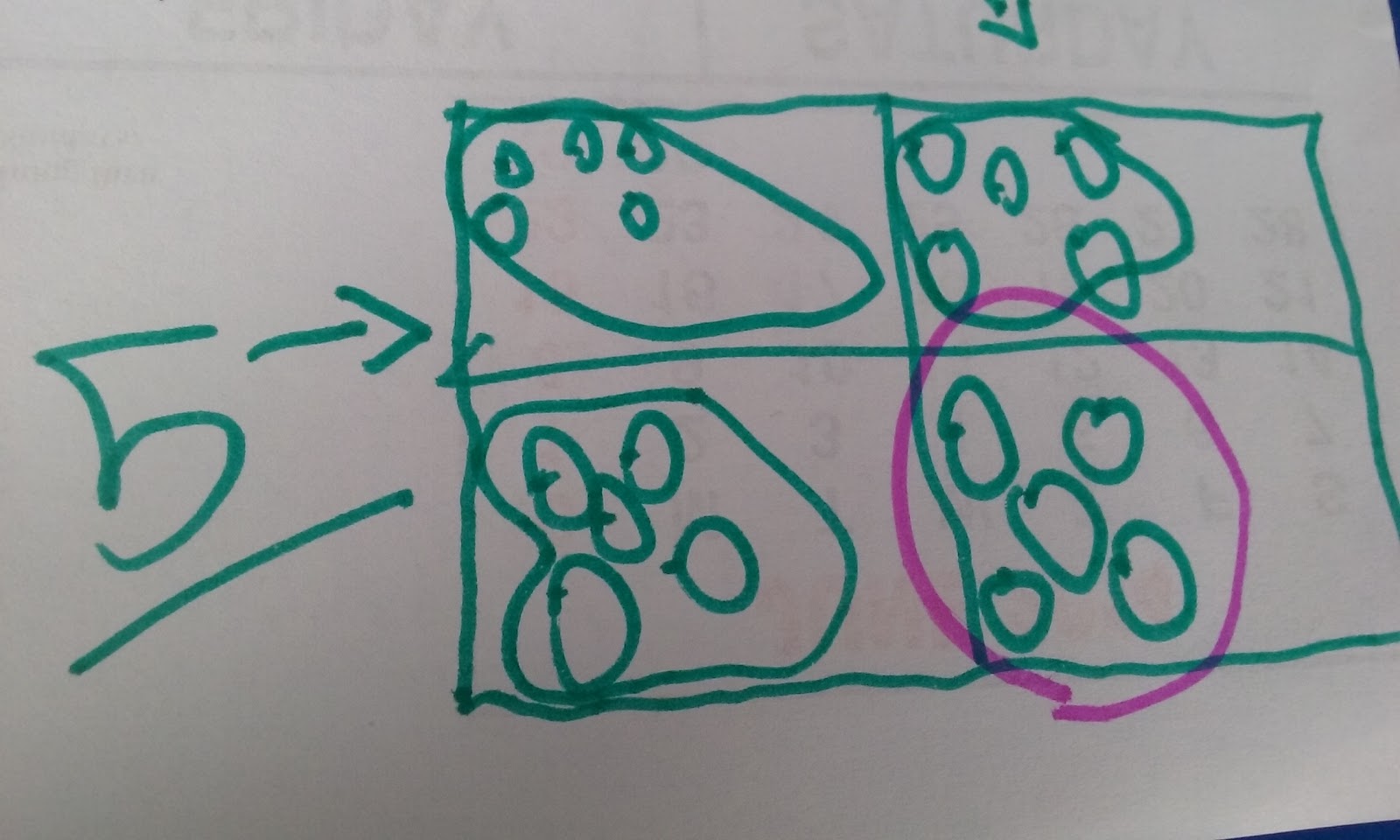
 It was interesting to see the different strategies they used. As you can see, 
- one group got distracted by Miss Ashley's friends and spent maybe a bit too much time drawing pictures of the friends (bless them!)
-most groups drew the pizzas or represented them by squares with four sections to show the quarters and counted out a quarter for each person until they had enough pizzas for the friends. 
-one group drew the pizzas, labeled each quarter, then had to 'name' each piece of pizza with an initial of one of the friends to ensure they didn't miss anybody.
-one group didn't draw any pizzas, and used their knowledge of doubles and their 4x tables. They knew that you need 4 pieces of pizza/1 whole pizza per 4 people, so they found one quarter of the number of people as their number of pizzas required.


 We came back together and shared all our different answers. I felt that the students were more open to sharing their thinking with an open ended question, as there wasn't as much chance they would be 'wrong' (compared to a closed question, where there was only one answer that could be right.)

Every group shared at least one answer, and the group who used their multiplicative knowledge could explain to the rest of the class what they did as well which was awesome!


I also loved how this activity cemented and demonstrated what the students have been learning about fractions for the past six weeks. Most of them instantly knew that 1/4 means you need 4 equal groups, they knew that 4 quarters made one whole pizza, and that you could have lots of quarters that then made lots of whole numbers.

Next time I use an open-ended question, I think I will use one that does reinforce what they have been learning, but frames it in a different way so they are challenged more by it. 
This could even be the wording the problem uses. 


Friday, 8 April 2016

Digital Immersion (day 9)

Today we began making our sites that we will use for teaching and learning in Term 2.

Here is my site.

It is built around our inquiry topic for term 2, which is

Reading for leisure, writing for pleasure

I played around a lot with this site, trying to get things where I wanted them to sit and creating the supporting HTML for my design. Over the past two weeks we have revised a lot of the things we learnt about HTML, especially the use of tables to hold content. My Inquiry site is made entirely using HTML formatting (rather than WYSIWYG formatting) which is quite an accomplishment for me. It is very helpful to refine my skills by creating different layouts, changing/merging cells in invisible tables, set theme colours, fonts and styles to override the automatic formatting.

Not to say I am an expert, certainly not. This page I literally scraped and started again, four or five times. It was difficult to get the page to do what I had in my head (diagonally downwards, L to R) using HTML. In the end, I discovered the best way to do it was to have invisible cells either side of each piece of content, and change the width of those cells to make each one sit either hard left, center, or hard right accordingly. I got there in the end, but no small feat!

I'd love to see what you think of this site.
Constructive criticism welcome! 
(Remember that this is made for my own learners, who are 6-9 years old and who are very new to using technology for learning)


Thursday, 7 April 2016

Implementing feedback!


One of the things I had to work on from my maths observation yesterday was talking about the problem more, and breaking down the question. 
Today I talked to the students about how I didn't do that part of our lesson, and if it affected their learning or not. 
They said it did, and that if I had explained it, they would have had a better understanding of what to do.
So today I made sure to break down the problem... 


We highlighted, drew circles and wrote on the board to pull apart the actual question, which parts are just information or context, and which were the important pieces of information. 


We then talked about what we knew already that could help us, and what things we had to do before we could get to the problem.

It was a wonderful learning opportunity for Room 6 to be able to talk about the teachers mistakes and how we can help the teacher learn from their mistakes. It reinforces that I am part of our team, I am a learner too and that we can ALL learn from our mistakes, even me. 

Wednesday, 6 April 2016

The perfect metaphor for teaching!


Today I heard the perfect metaphor for teaching and just had to share it.
Rebecca, one of my uni lectures told us that teaching is like riding a mountain bike.
Below, I explain in my own words.


When things are going great, you feel like you are flying.
When they are not, all you can do is hold onto the handle bars, try to stay upright and hope for the best outcome.
When you are scared, in the pit, or taking a huge risk, all you can do is take a deep breathe, roll over the edge of the mountain, and hold on tight.
When you are obsessing about trying to get everything piece of data in, assessment marked, blog commented, it is like you are too busy fiddling with the gears that you forget to pedal.

New teachers tend to look straight down, at the wheel in front of them. They are worried about what they are doing now. The hurdles, the bumps, the nooks and crannies we can fall into. It is almost like we are just trying to avoid things that will knock us down. 
New teachers are just trying to keep peddling the bike. 

More experienced teachers, look up. They ride their bike with their heads held high, trusting in themselves they know what is on the ground in front of them and how to deal with that. They look into the distance, the long term goals for their student achievement. It is not a mentality of 'what am I doing today?', but of 'If this student needs to be at X level by the end of the year, they need to move Y levels every month and how can I best facilitate that learning?'
Experienced teachers look up towards the horizon, confident they can keep peddling.

And both of those are okay. 
Even as a new teacher, sometimes I will feel confident enough to quickly glance up and check what is on the horizon. Other times, I will be so busy taking deep breathes and holding on tight and trying not to fall off my bike, that I won't have the energy to look up. 
And that's okay. That is part of riding the bike. 
That is part of the journey.


Maths observations

Today I was observed by Sue Pine, our TPS Maths PLG leader (an expert bought into the school to help us get better at teaching maths.)

Eek! Although I was nervous, I did feel as though I have gotten a lot better in the past few weeks at teaching maths and using talk moves and number talks. (Scroll further down in my blog to see previous observation notes.)

I knew I was proud of how far I have come, so having somebody observe me and give me next steps was a nerve wracking next step for me.

Things I did well
A well worded problem
 (Sue even said that this would be a really good national standards problem for testing the strategies students know and used, as there are many ways to solve it.)

Connections
(I used the same number for my number talks as in my problem (24) so students could apply the knowledge they had talked about in the number talks to their feijoa word problem.)

Structure
(I used a good structure of my lesson and it generally flowed nicely from one activity to another.)


Things to work on
Launching the problem
(I can work on this by ensuring I read the problem aloud, then talking to the students about the problem and ensuring they understand what the problem is asking them to do, what are the important parts etc.)

Pace
(I can keep working on this by choosing wether to do number talks or the warm up, whereas I had been doing both of them. This will cut ten minutes out of my lesson and help me speed it up. Another thing I can work on is getting the students who have understood the problem and are just sitting to get started with their follow up work, and continue my eliciting answers and talking about them with most of the class instead of all of the class, then quickly moving onto smaller group clinics with those students who need it most.)

Other notes
Growth mindset
(Sue pointed out that at one point, I told a student 'you are so smart'. This encourages a fixed mindset. I always try to make my praises about the learning, but evidently some comments still slip through. Tomorrow I will be sure to change my comments to things like 'you are thinking very hard', 'you explained your thinking very well'.)


Friday, 1 April 2016

Digital Immersion (day 8)

Today in our digital immersion, we collaborated on a current events site, that when it is finished, will be gifted to the teachers of Manaiakalani for them to use, and to use a template as well.

This is our site.

As you can see, each section is a different current event, designed around a different group of learners/learning age.

This is my page - be sure to scroll down!


At a surface level, I have created my learning based around the changing of China's one child policy. Although this is not a current event in April 2016, I felt that it was an interesting enough of a story and had enough meaty content that I could relate to my learners, so I chose it anyway. I have included a full weeks worth of planning, learning outcomes and success criteria, and all the resources you would need to complete this study down the bottom of the page. 

At a deeper level, unseen from the naked eye, is the cementing of my own knowledge by using HTML code to create this page. I also used tables to structure my content, and then had to revise how to make the borders invisible, change sizes of cells, merge cells, add rows, add colour to cells etc.  None of the formatting on that page is pre-made, I created it myself.

I am quite proud of this site, as it not only cemented my own knowledge and challenged my HTML abilities, but is now a resource I can use in my school and class, and others can use as well.

Thursday, 31 March 2016

Accelerating learning!


We have been doing fractions for the past two weeks... Mainly trying to get the students to understand what halves and quarters are, then moving them onto understanding that half a half is a quarter, so two quarters is the same as one half etc. Only two of the students in my class can independently find multiple parts of a whole, (e.g. 3/4, 5/6). The rest are still finding one of (e.g. 1/3, 1/4, 1/2)

In a one hour session today, I helped move three of my lower achieving students up in the strategy they use and how they express their thinking. 


We started with this... (which was irrelevant to our question, but that is besides the point.) The point is he couldn't explain verbally, visually or anyway how he got his answer. 

I explained to them how with fractions, the bottom number is how many groups you have. We practiced splitting numbers into groups and that the top number is how many groups you are looking at. For example, half of ten means you put ten into two groups (because the bottom number is 2) then look at how many are in one group (because the top number is a 1).

I started giving the students fraction word problems about 1/4, 1/2, 1/3 and they were getting it and could draw their thinking, and then talk about what they drew as a way of explaining how to get their answer. 


Our question here was -
'Dad has 20 cookies and gives 1/4 to each of his 3 children. The rest he gives to mum. How many cookies did mum get?

Notice how they have drawn four squares, (which shows me they understand that for quarters you need 4 groups), put dots in each box to represent the cookies (which shows me they understand how to share things equally), circled one box (which shows me they understand they are looking for ONE quarter, rather than two or three quarters) and written the number of cookies mum gets next to their drawing (which shows me they can find part of a whole).

How much learning can be seen in one snapshot of a students drawing is amazing isn't it...

They seemed to find quarters, halves and thirds easy by using this strategy, so I upped the anti and gave them fractions even the rest of the class hadn't seen yet. Sixths, sevenths, tenths etc, and asked them to find multiple parts.

I gave the students variations of this word problem
'Miss Ashley has (X) number of lollies and gave (fraction) to the green table. How many lollies did she give them?'
Here is their thinking...
(K, C and L are the students initials, to protect their identity.)


 K - Miss Ashley has 20 lollies and gave 2/4 to the green table. How many lollies did she give them? Also seen here on the left side is the answer to 'Miss Ashley has 30 of lollies and gave 1/3 to the green table. How many lollies did she give them?'
 C -Miss Ashley has 35 lollies and gave 1/5 to the green table. How many lollies did she give them? 

 C - Miss Ashley has 35 lollies and gave 2/7 to the green table. How many lollies did she give them?
 K - Miss Ashley has 25 lollies and gave 2/5 to the green table. How many lollies did she give them?
 L - Miss Ashley has 35 lollies and gave 5/7 to the green table. How many lollies did she give them?

 L - Miss Ashley has 50 lollies and gave 9/10 to the green table. How many lollies did she give them?

L - Miss Ashley has 30 lollies and gave 8/10 to the green table. How many lollies did she give them?

 C - Miss Ashley has 30 lollies and gave 2/10 to the green table. How many lollies did she give them?

They went from barely knowing what halves and quarters were, to being able to find 9/10 and 5/7 of a  number. Incredible! I was so proud of them for stepping up such a HUGE amount during one hour of intensive teaching, and I could see they were buzzing and were proud of themselves as well. They were actually sad to pack up for morning tea!


Tuesday, 29 March 2016

Maths observation

Today Archana observed me taking maths with our class. 
I won't post the observation notes on here, but here is a summary.


Things I did well
"I liked the way you did number talks and warm up activity. You launched the problem and it was clearly worded for the students. You tried to use Talk Moves when students were sharing their mathematical thinking though the one that you used was mainly when students were repeating themselves."

Things to work on
Minimising talking during independent think time. 
(I can work on this by clearly stating my expectation of the noise level and behaviour before the students leave the mat, and praise them for working to my expectations throughout the think time). 

Leaving the students alone during independent think time - not prompting them.
(I can work on this by just looking at their work and not asking them questions about what they have written/drawn. If they ask me a question, I can tell them that we will talk about it later in whole class time). 

Having the WALT displayed and referring to it
(I can work on this by having the WALT written out on an A3 paper and putting it up everyday, rather than leaving the opportunity for me to forget to write it everyday. I also need to explain what it means and break down the words to ensure the students understand them.)

Pace of the lesson
(I can work on this by only doing 2 warm up questions with the squeezey boxes, and giving the students less time for the number talks. They have been doing this for a while now and don't need as much time as they used to.)

Modelling book
(I can work on this by having the question pre-written onto the modelling book and leaving it within my sights (not putting it to the side) so I remember to use it. I did take a clinic, but I did not the modelling book to record the groups thinking)

Wednesday, 23 March 2016

Encouraging metacognition


Everyday, I ask my students, "what did you learn today?"

And every time I ask them, they always have something to say. I accept (most) answers, as all learning matters. What they learn in maths and reading is important, yes, but so are developing social skills and their ability to think and talk about their own learning.

It is a class, syndicate and school wide goal to get our students to think more about their own thinking (metacognition) and to talk about their thinking. Simply asking them for one thing they learnt that day is a great way to get them to

  • think about the new things they learnt that day
  • to have their learning on their mind as they are walking out the door at the end of the day instead of what they did at lunchtime. 
This is Tuesday's response

Today I learnt... 23 March 2016 from Tamaki Primary on Vimeo.

You will notice a lot of them talked about their blogs, as we did a focus session on accessing their blogs and how to post for the first time (they are very new to their blogs).

I plan to show them this video, and talk about the benefits of talking about our learning, and different ways we can show what we have learnt.


Friday, 18 March 2016

Learning for/through/because of/by teaching.


This week has been a huge week.
I found myself waking up, and my first thought being 'I am so excited to hang out with my learners today'. I found myself coming home from school, and happily spending hours on planning, because I was so excited about their learning I couldn't stop myself.

I was working on this. 

Creating this site was so exciting for me. Is that nerdy to admit? I don't know, but I don't care.
We learnt how to make them on one of our digital immersion days, and have been taught little bits here and there of how to make them better. I was proud of my site and the planning I had done on it for my learners. I showed it to my mentor the next morning and she got excited too...
(and wanted to know how to make one too - teaching point for me!). She also left me an encouraging comment on the bottom of the site if you want to read it.

Then, at digital immersion today, we were shown how to insert invisible tables using HTML and how these make your site look better and also make it more adaptable on different devices, as photos, videos (etc.) are forced into place and can't shift around your web page. This is perfect for my learners who use netbooks, as their screen size is different to mine.

So then, I updated my site! It now has both WYSIWYG formatting and HTML formatting 
(I'm still learning! It won't be perfect just yet....)

My reflection on this site though is not about the formatting of my site, but how much learning has gone into it and come out of it.

Learning for teaching
I first learnt how to make a site to benefit my teaching skills and my learners.
Learning through teaching
I am continually learning what strategies, preferences, multimodal options (etc.) work best for my learners, when I am teaching them
Learning because of teaching
Teaching isn't static. It is always changing, and so my practice should be as well. As teachers we need to constantly be keeping up with 'the times' of effective/best practice, and using these digital tools is one of those things.
Learning by teaching
I am cementing my own learning by teaching these skills and knowledge to my mentor.


So many different types of learning and teaching, interlocked and intertwined, interdependent and interrelated. If that doesn't summarise being a teacher, I don't know what will.

Digital Immersion (day 7)


Today we had a field trip to Stonefields school for the Manaiakalanai School leaders study tour.
Their principal Sarah Martin did a seminar about collaboration and communication that I got a lot out of. As the principal, she obviously spends a lot of time with her staff, and with an ever-growing number of staff and having 11 new teachers this year, she used a lot of strategies to get everybody on board and on an equal playing field. Along with that huge number of staff comes with collaborative issues. How can people work together when they all are so different? How can we prevent elephants in the room becoming conflicts? How do we deal with conflict when it arrises?

One thing she talked about was having a shared vision of where you want to be. What she did with her staff, which I plan to now do with my students in our own way, was get them to draw where they think they are now in terms of their collaboration, and then where they want to be. This gave them a vision and gave the staff strategies for when there are elephants in the room.

So...
Food for thought...


Where do I think I am with my collaborative efforts?
The person on the left is me, with a strong connection to and from my mentor teacher. I recognise that I only have bonds with some of the other staff members of my school, and that there are some people I do not collaborate with.

Goal for the future?
Get to know everyone! I need to build relationships with those people that I may not necessarily see everyday - people in the junior syndicate and support staff in particular. This will build my collaborative community as I can then talk to these people about anything and give and receive support!


Friday, 11 March 2016

Learning to create or creating to learn?


This week we have started serious work using our netbooks and introduced our student blogs
At Digital Immersion (day 5)  we talked about the difference between learning to create, and creating to learn. And yes, there is a difference. 
Learning to create - where learning is the process and the 'creation' is the final outcome. 
Creating to learn - where creating is the process and learning is the final outcome.

Which is better? Is one better than the other? Why or why not?

Image result for learn

That made me think about my learners and their blogs. This week, I have been trying to teach them about their netbooks. I felt they need to gain the knowledge and skills about how to use their netbooks before they can use them in-depth for learning. However, they actually are sort of picking most things up a long the way all by themselves. They may not know the names of the different parts of their netbooks, but they are figuring out how to use them...

So... am I teaching them to learn how to create, or teaching them to create to learn?
Which should I be doing? Why is that one better?
Or should I be doing a mixture of the two... Explicitly telling them things they probably won't discover on their own, but also letting them figure out for themselves what they can..

What do you think?

Digital Immersion (day 5)


Sourced from: https://commons.wikimedia.org/wiki/File:Logo_Google_Sites.png


Today we talked a lot about using Google Sites for effective practice, and how in creating your Site we are determining access to learning for students and their families.


We discussed the ten top principles for effective web design -

  1. Usability and the utility
  2. Obvious and self-explanatory
  3. Remove all barriers - no access denied or sign up required
  4. Focus users attention - visual cues, carefully chosen text
  5. 3 Clicks ( or 1-2-3-done-steps)
  6. Effective writing
  7. Simplicity - Clean
  8. Embrace White Space - not crowded
  9. Conventions are our friends - consistent layout, icons, Home button etc
  10. Test early, Test often.  Check using Incognito or Safari


We then critically analysed some sites provided to us, for their;
  1. learner engagement
  2. Whanau access (including language used)
  3. use of multimodal learning


Our end goal is to create our own site where we can use the best of all we learnt. 
Just for today though, we discussed, critically analysed and sourced resources for our chosen current event.
Here is my slide from our slideshow -


We then will use this planning to create and share our current events site next week!


Friday, 4 March 2016

Digital Immersion (day 4)


Today we talked a lot about Google Sites, and touched on other background things such as writing HTML and embedding outsider gadgets.

As I use a ready-made syndicate site at school, and my PRT site was made from a template, I have not made a site from scratch before. It may seem a bit bland to make a 'sandpit' site, one designed purely for someone to play around it, for hours, but it afforded me a lot of learning opportunities.

I now know how to create a site, change all of its settings, layout and design features, turn particular features on/off, add content from many sources and then 'bling' it up (aka making it pretty).
It will be awesome to create on I can use for my learners, as I can design it in such a way that makes sense to myself and my learners.

I also learnt a little bit about how to read, write, edit and embed HTML code.
Here is a little Youtube explanation of what HTML is.

Note: this Youtube video is inserted into this blog post using HTML! 

We played around with inputting resources from different sources into a Google Site, and shared these with each other. 


Thursday, 3 March 2016

Impromptu Observations


During my release time today, I was supposed to be completing our weekly plan for next week. However as I sat in the class sorting out what I needed etc, I became aware of an amazing lesson going on right before my eyes. I instantly started recording notes, unbeknown to the teacher (my mentor, Archana). Of course she figured out that I was observing her when I quickly went and took photos of the whiteboard, kept typing while she spoke and didn't appear to be doing any planning haha! But wow, the results were amazing!
The focus I chose was seeing how many times the teacher either used talk moves, or praised the students, and in what way. See for yourself... (hint: I have highlighted the key pieces.)
As you can see, there was soo much rich use of talk moves, maths language and positive behaviour reinforcement used by the teacher in this hour session. The more I analysed the results, the more it made me think about what kind of things I say to the students...

(I have taken the actual observation out of this post for privacy reasons, as it contains personal information about students including their names.)

I want to note that I don't want to replicate what my mentor teacher has done, as I am my own person and not a clone of her, however wonderful she may be. My point is, that maybe I need to watch what I say to the students, and how I am saying it. How can I get the same level of engagement and excitement about maths?  Do I refer to our class treaty that much? Do I build them up just for trying that much? Do I connect with them on a personal level, still in whole class situations? If not, how can I? How can I set such a tone for the love of learning?